
“A classic is a book that has never finished saying what it has to say.”
Italo Calvino
I’ve been thinking about that sentence lately.
Not because of the classics, but because of the ordinary books.
Thousands of them are now being bought, their spines cut away, their pages scanned, and the remains discarded. The purpose isn’t destruction; the purpose is efficiency.
I understand the logic. I also understand the extraordinary potential of AI.
What I find harder to understand is something else, why does this feel like an acceptable price to pay?
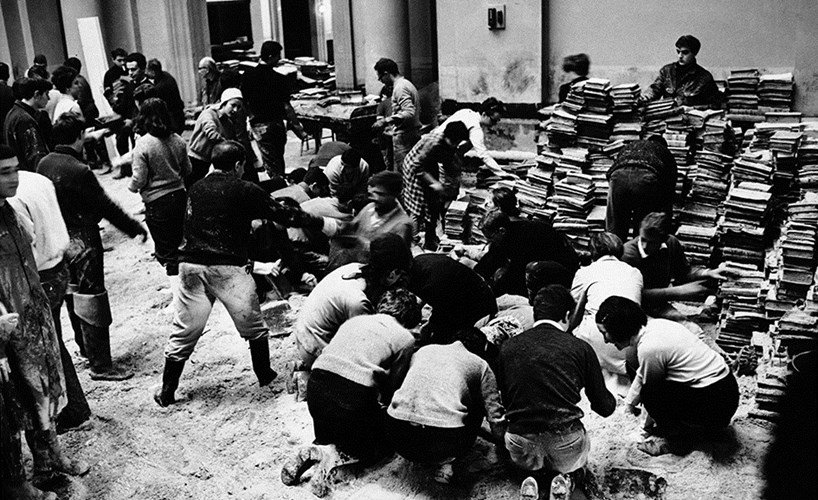
In 1966, when the Arno flooded Florence, thousands of volunteers travelled from across the world to rescue waterlogged books. Conservators, bookbinders and students formed human chains, passing damaged volumes from hand to hand because they believed they were worth saving.
Sixty years later, we possess technologies capable of scanning books without destroying them. They simply ask for something efficiency rarely does: care.
Yet we increasingly choose otherwise.
A scan preserves the text. A book preserves something else more difficult to define.
Not just information.
Evidence.
Information can be copied indefinitely. Evidence has to exists somewhere.
A printed book fixes an idea in time. Once it enters the world, it becomes independent of its author. It can be ignored, rediscovered, challenged or celebrated. It may spend decades on a forgotten shelf before finding the reader who finally understands why it mattered. Or it may never matter at all.
We simply don’t know. History suggests we are remarkably poor at knowing what the future will value. That uncertainty is precisely why preservation matters.
Perhaps this isn’t really a question about AI.
Perhaps it’s a question about what we believe culture is.
Every generation decides what it chooses to preserve.
Every generation also decides what it is willing to sacrifice in the name of progress.
The moment we stop noticing that trade-off may be the moment we’ve already accepted it.
And I can’t help wondering:
When the object disappears, what becomes our anchor?
Unit B1 , 419 Wick Lane
London, England, E3 2PX
07972807308
Your Custom Text Here
Summary Block
